

How to Play Online Poker: Technical and Strategic
Analysis of online poker that combines mathematics, game theory and digital psychology, exploring strategy, bankroll management and profitable decisions.

Analytical Treatise on Technical and Strategic Excellence in Online Poker
Poker's transition from physical environments to digital ecosystems represented not just a change of platform, but a fundamental evolution in the game's epistemology. Online poker, in its contemporary form, is a discipline that requires the synthesis of rigorous statistical analysis, applied game theory and a deep understanding of behavioral psychology mediated by technological interfaces. The absence of traditional physical signals — such as facial micro-expressions or bodily mannerisms — has shifted the strategic focus to timing patterns, betting frequencies and the exploration of information asymmetries through mathematical models. This report details the pillars that support professional success at the virtual table, from mechanical fundamentals to elite tactics.
Mechanical Fundamentals and Structure of Texas Hold'em
Mastering Texas Hold’em, the predominant modality on the global stage, requires absolute understanding of its rules and phases, which serve as the framework for any subsequent strategic construction. The game is defined by the search for the best combination of five cards, using two private cards for each player and five community cards distributed in different phases. Victory is achieved by possessing the strongest hand in the final confrontation or by inducing opponents to give up through strategic aggressiveness.
Hand Hierarchy and Relative Value
Understanding the official ranking is the first step towards equity analysis. Each combination has a mathematical probability of occurrence, which determines its relative strength in the long term.
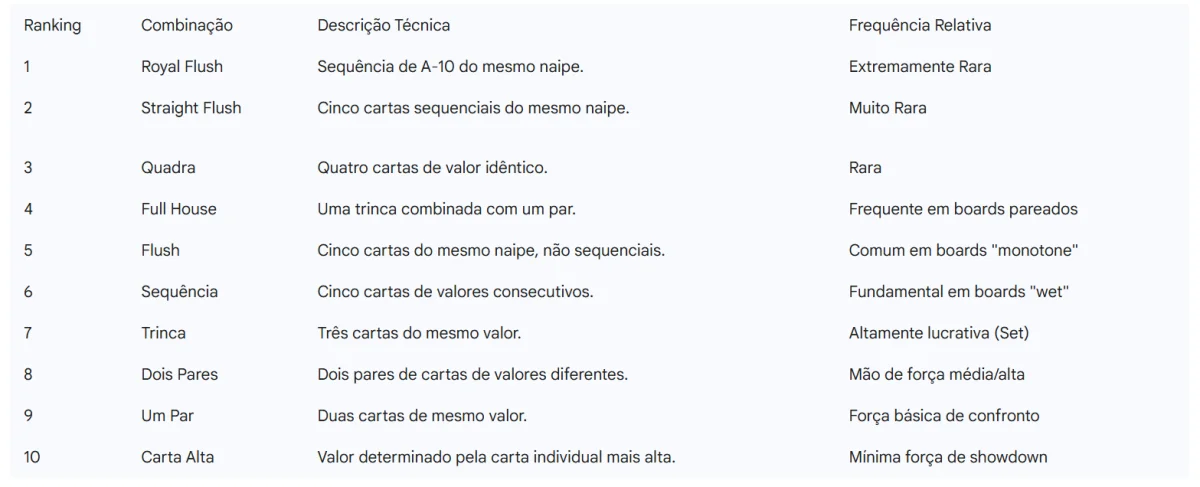
In situations of a tie, the winner is determined by the highest card in the combination or by the "kicker", which is the tiebreaker card that is not part of the main combination. The suits do not have hierarchical value differentiation, serving only for the composition of flushes.
The Action Cycle and Betting Rounds
The game flow is divided into four betting rounds, each offering new variables and information. Before the deal, two players place mandatory bets called "blinds" (small and large), which guarantee the existence of an initial pot to compete for.
- Pre-Flop: The initial round where each player is dealt their two hole cards. The decision to enter the pot is based on the absolute strength of the hand and relative position at the table.
- Flop: The revelation of the first three community cards. This phase defines the direction of the hand and allows the first estimates of real equity.
- Turn: The fourth community card is dealt. The number of variables increases and the pots tend to grow exponentially.
- River: The fifth and final community card. With no more cards to come, decisions are based purely on the ultimate strength of the hands or the effectiveness of the bluffs.
- Showdown: The moment of truth where the cards are revealed to define the winner, if the bets have not forced previous withdrawals.
Table Geometry: Position and Hand Range
Table position is the efficiency multiplier of any strategy. In online poker, acting last provides an informational advantage that often compensates for holding technically inferior cards. Position dictates the volume of hands that can be played profitably.
Position Categorization and Information Dynamics
Positions are divided into groups that determine the rigidity or flexibility of starting hand selection.
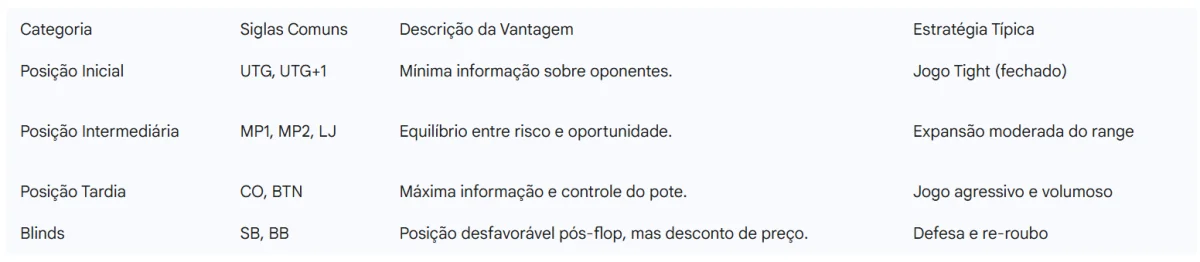
The Button (BTN) is the most profitable position in the game, as it allows you to observe the actions of all opponents in all post-flop rounds. Conversely, Under the Gun (UTG) requires extremely rigorous selection, as the player will have to face the action of the entire table without knowing how the opponents will react to their bets.
The Science of Starting Hand Selection
Real profitability comes from the balance between the strength of the cards and the context of the table. Hands that are profitable on the Button can be losers if played from UTG.
- Premium Hands: AA, KK, QQ, AKs and JJ. They must be played with maximum aggression in any position, frequently applying re-raises (3-bet) or responding to them (4-bet).
- Strong Hands: AKo, AQs, KQs and middle pairs (TT-77). Highly profitable, but require caution against signs of extreme strength from opponents in early positions.
- Speculative Hands: Suited connectors (e.g. 87s, 98s) and low pairs (22-66). They gain value in multi-way pots and when stacks are deep, due to the high potential to form hidden and powerful hands such as straights and trips.
- Trash Hands: Disconnected combinations of different suits (e.g. 72o, J4o). They must be discarded immediately to avoid situations of dominance and unnecessary losses.
Mathematical Decision Theory: Probabilities and Expected Value
Online poker is, fundamentally, a battle of mathematical approximations. Success is not measured by the outcome of an individual hand, but by the quality of decisions in terms of Expected Value (EV). Each action must be analyzed based on the relationship between risk and potential reward.
Equity and the Out Count
Equity represents the portion of the pot that statistically belongs to the player based on his or her chances of winning at showdown.9 To calculate it, one must identify the "outs" — cards remaining in the deck that turn a losing hand into a winning one.
The most efficient technique for quick calculations during the game is the Rule of 2 and 4:
- On the Flop: Outs x 4 = % chance of improving to the River.
- On Turn: Outs x2 = % chance of improving on River.
For example, a player with a Flush Draw (9 outs) on the flop has approximately 9 x 4 = 36% equity against a made hand.
Pot Odds and Call Mathematics
Pot Odds determine whether the price paid to see the next card is fair relative to the probability of completing the hand. The basic formula for calculating the need to win is expressed by:

The correct mathematical decision is: pay if your equity is greater than the need imposed by the Pot Odds. If the pot offers a 3:1 return (25% need) and the player has 36% equity, the call is profitable in the long run.
Implied Odds and Future Potential
Implied Odds expands the Pot Odds calculation by including the money the player expects to win on future rounds if he completes his hand. This concept is vital when chasing draws against aggressive opponents who are likely to call large river bets. Even if the current price on the Turn is not favorable, the potential future profit may justify staying in the hand.
Post-Flop Aggression Strategies: C-betting and Check-Raising
Aggressiveness is the engine of profitability in online poker. Passive players, who only call bets, become predictable and miss the opportunity to win pots through "Fold Equity" (the probability of their opponent folding).
The Continuation Bet
A C-bet occurs when the pre-flop aggressor maintains the initiative by betting the flop, regardless of whether he hit the board. The basis of this play is the statistical fact that opponents miss the flop approximately two-thirds of the time.

C-betting on dry boards with high cards favors the original aggressor, whose range contains more high pairs and aces. Coordinated boards favor the range of those who only defended the blind, requiring larger bets for protection or simply checking to avoid aggressive check-raises.
Check-Raise as a Defense and Value Tool
A check-raise is an aggressive action taken out of position, where the player checks with the intention of raising after the opponent's bet. This maneuver is used to:
- Extract Maximum Value: With very strong hands against aggressive opponents.
- Semi-Bluff: With powerful draws, forcing the opponent to give up their equity immediately or building a huge pot for when the draw is completed.
The semi-bluff is considered the "golden ticket" of a balanced range, as it offers two ways of winning: the opponent's fold or the improvement of the hand on the following streets.
Advanced Pre-Flop Dynamics: 3-Betting and Range Construction
In higher level games, the pre-flop battle intensifies through 3-bets. A well-executed 3-bet defines the dynamics of the hand, isolates weak opponents and builds pots with high-equity hands.
Range Models: Linear vs. Polarized
The choice of hands for a 3-bet depends on the opponent's tendencies (Villain) and the available Fold Equity.

Using a polarized range allows medium strength hands (like 88 or ATs) to be kept in the "calling" range, realizing their equity more cheaply, while bluffing hands (like A5s or K9s) put maximum pressure and have "blockers" against the opponent's stronger hands.
Digital Psychology and the Science of Online Tells
The absence of eye contact in online poker does not eliminate the presence of behavioral patterns. The focus shifts to "Timing Tells" — the time it takes a player to process a decision.
Decoding Action Time
Time is a variable that reveals the state of confidence and the complexity of the opponent's mental process.
- Insta-Call (Instant Pay): Generally indicates a hand of medium strength or a weak draw that had already decided to call before the action. Players rarely call instantly with very strong hands ("nuts"), as they tend to think about how to maximize value.
- Long Hesitation followed by Check: Often signals weakness. The player considered it a bluff, but folded, hoping to now take the hand to the showdown for free.
- Pre-configured Actions: The use of automatic action buttons (such as "check-fold") indicates a lack of attention or disinterest in the pot, allowing aggressive attacks against these profiles.
Tilt Management
Tilt is the biggest bankroll destroyer in online poker. The fast pace of virtual tables can generate rapid losing streaks that trigger irrational emotional responses. Elite professionals monitor their physiological signals and set strict stop-loss limits to stop sessions before strategic judgment is compromised.
Financial Engineering: Banking and Variance Management
Bankroll Management is the infrastructure that allows a talented player to survive the inevitable periods of bad luck, known as "downswings". Skill is irrelevant if capital is insufficient to support statistical variance.
Golden Rules for each Modality
Variance differs drastically between game formats, requiring different levels of capitalization.
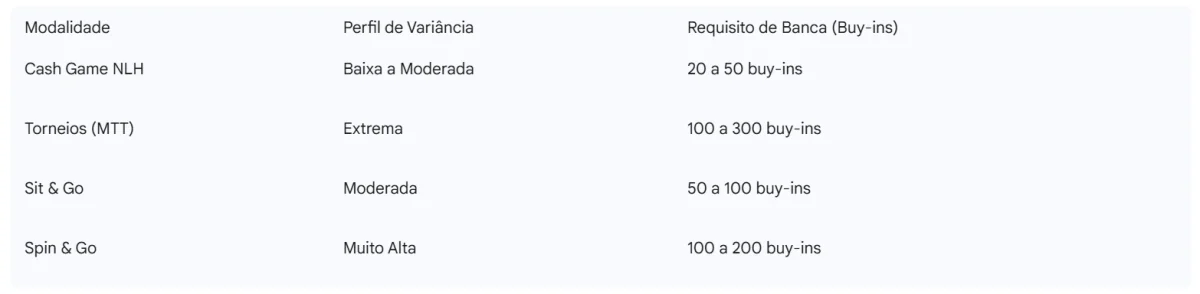
The "buy-in" is the entry fee into a table or tournament. A player must level up only when his bankroll comfortably exceeds the upper limit of the recommended reserve for the next level and must be downgraded if it falls below the safe limit of the current level.
The Modern Gamer's Technological Arsenal
Professional online poker is inseparable from data analysis tools. This software does not replace human decision-making, but informs it with surgical precision.
HUDs and Tracking Software (Trackers)
The Heads-Up Display (HUD) projects statistics about opponents directly onto the gaming table, based on collected hand history.
- VPIP (Voluntarily Put Money in Pot): Measures how "loose" or "tight" a player is.
- PFR (Pre-Flop Raise): Indicates the level of pre-flop aggression.
- AF (Aggression Factor): Relates bets and raises with calls.
Using these statistics allows you to quickly identify competent recreational and regular players, adjusting your strategy to exploit the specific trends of each profile.
Volume Optimization: Multi-tabling
- Multi-tabling is the practice of playing multiple tables simultaneously to increase your hourly win rate. While this practice increases potential profit, it reduces the depth of analysis on each individual decision.
- Tiling (Side by Side): Improves overview and perception of trends.
- Stacking: Focuses on execution speed, ideal for players who use a strategy based on "ABC Poker" (solid and simple game).
Considerations on the Evolution of the Game and Professionalism
Online poker is moving towards a state of theoretical "solution" through the use of solvers and artificial intelligence. However, the real profitability for humans lies in the ability to deviate from mathematical balance to exploit the emotional and strategic errors of opponents. The modern professional must be a polymath: a mathematician in equity decisions, a psychologist in reading patterns and a financial manager in managing his capital.
The journey to virtual tabletop mastery doesn't end with learning the rules; it starts with accepting that poker is a long-term game. The focus should always be on the decision process, not the immediate result. Resilience in the face of variance, combined with incessant technical study, is the only sustainable path to excellence in one of the most challenging competitive environments in the digital world.
Get in on the action now at PokerFi ♠️🔥
Show your skills, compete in exciting tournaments and play against real people on a modern, safe and adrenaline-filled platform.
Whether you are a beginner or a professional, PokerFi is the right place to elevate your game.
👉 Get started now: https://play.pokerfigame.com
References
-CBTH. Regras do Texas Hold'em. Disponível em: https://www.cbth.org.br. Acesso em: 2025.
-888 POKER. Texas Holdem Online – Aprenda as regras e como jogar. Disponível em: https://www.poker.888.pt. Acesso em: 2025.
-TABLE GAMES. Regras: como jogar Poker. Disponível em: https://www.tablegames.com.br. Acesso em: 2025.
-PARTYPOKER. Mãos do Poker: sequência das mãos. Disponível em: https://www.partypoker.com. Acesso em: 2025.
-UMDOISESPORTES. Poker Texas Hold'em: aprenda as regras e como jogar. Disponível em: https://www.umdoisesportes.com.br. Acesso em: 2025.
-POKERLISTINGS. Posições no Poker: como jogar em cada posição. Disponível em: https://www.pokerlistings.com.br. Acesso em: 2025.
-POKER NO BRASIL. Tabela de mãos iniciais (Starting Hands). Disponível em: https://www.pokernobrasil.com. Acesso em: 2025.
-POKERSTRATEGY. A matemática do Poker: Pot Odds implícitas. Disponível em: https://www.pokerstrategy.com. Acesso em: 2025.
-POKER NA CHAPA. Matemática do Poker: Pot Odds, EV e cálculos essenciais. Disponível em: https://www.pokernachapa.com.br. Acesso em: 2025.
-WORLD POKER FEDERATION. Pot Odds no Poker: guia completo. Disponível em: https://www.worldpokerfederation.org. Acesso em: 2025.
-CHECKRAISE. Pot Odds e equidade: como calcular decisões matemáticas. Disponível em: https://www.checkraise.com.br. Acesso em: 2025.
-888 POKER. Poker Odds: Implied Odds e Pot Odds. Disponível em: https://www.poker.888.pt. Acesso em: 2025.
-POKERNEWS. Calculadora de probabilidades de Poker. Disponível em: https://br.pokernews.com. Acesso em: 2025.
-SMART POKER STUDY. Continuation Betting Fundamentals. Disponível em: https://www.smartpokerstudy.com. Acesso em: 2025.
-POKERSTARS. Continuation Betting in Poker. Disponível em: https://www.pokerstars.uk. Acesso em: 2025.
-CARDPLAYER. Check-Raise Strategy in Poker. Disponível em: https://www.cardplayer.com. Acesso em: 2025.
-MICROGRINDER. 3-Betting 101: Linear vs Polarized Ranges. Disponível em: https://www.microgrinder.com. Acesso em: 2025.
-REDDIT. Linear vs Polarized 3-Betting Ranges. Disponível em: https://www.reddit.com/r/poker. Acesso em: 2025.
-POKER.PRO. Raise the Right Hands: Linear & Polar 3-Bets. Disponível em: https://www.poker.pro. Acesso em: 2025.
-TWO PLUS TWO FORUM. Polarized or linear 3-bet range OOP? Disponível em: https://forumserver.twoplustwo.com. Acesso em: 2025.
-HAND2NOTE. How to decide which hands to 3-bet preflop. Disponível em: https://www.hand2note.com. Acesso em: 2025.
-LEGAL US POKER SITES. Tilt in Online vs Live Poker. Disponível em: https://www.legaluspokersites.com. Acesso em: 2025.
-PRIMEDOPE. Mastering Online Poker Tells. Disponível em: https://www.primedope.com. Acesso em: 2025.
-BLACKRAIN79. Poker timing tells and betting patterns. Disponível em: https://www.blackrain79.com. Acesso em: 2025.
-NEW VALLEY NEWS. Mental preparation: live vs online poker. Disponível em: https://www.newvalleynews.co.uk. Acesso em: 2025.
-REDDIT. Gestão de banca no Poker. Disponível em: https://www.reddit.com/r/poker. Acesso em: 2025.
-PARTYPOKER. Gerenciamento de banca no Poker. Disponível em: https://www.partypoker.com. Acesso em: 2025.
-CHECKRAISE. Gestão de banca: torneios vs cash games. Disponível em: https://www.checkraise.com.br. Acesso em: 2025.
-POKERSCOUT. Gerenciamento de bankroll no poker. Disponível em: https://www.pokerscout.com. Acesso em: 2025.
-POKERSTARS. Gerenciamento de bankroll. Disponível em: https://www.pokerstars.com. Acesso em: 2025.
-888 POKER. O que é Buy-in no Poker? Disponível em: https://www.poker.888.pt. Acesso em: 2025.
-POKERNEWS. Ferramentas de Poker: solvers e calculadoras. Disponível em: https://br.pokernews.com. Acesso em: 2025.
-REDDIT. Uso de softwares como PokerTracker. Disponível em: https://www.reddit.com. Acesso em: 2025.
-POKEROLOGY. Multi-tabling poker strategy. Disponível em: https://www.pokerology.com. Acesso em: 2025.
-DM CRÉDITOS. Multitabling: quantas mesas jogar? Disponível em: https://www.dmcreditos.com.br. Acesso em: 2025.
Want to Learn More? Explore: Play Online Poker
Related Posts

How to Play Draws in Poker and Maximize Your Profits
Learn how to play draws in poker, calculate outs, use pot odds, apply semi-bluffs, and make profitable post-flop decisions.

How to Defend the Blinds and Win More at Poker
Learn how to defend the blinds correctly in poker, reduce preflop losses, and make more profitable decisions in cash games and tournaments.

How to Exploit Recreational Players in Poker
Learn how to exploit recreational poker players with practical strategies for Cash Games, MTTs, Sit & Go tournaments, and Online Poker.