

Sit & Go Strategy 2025: Advanced and Profitable Guide
2025 Sit & Go Strategy: Play tight early, dominate the ICM on the bubble and use solvers to profit in online poker.

The Rebirth of Sit & Go in the 2025 Ecosystem
The online poker landscape in 2025 witnesses a phenomenon of unprecedented technical specialization. While Multi-Table tournaments (MTT) continue to attract big prize pools, Sit & Go (SnG) tournaments have established themselves as the essential laboratory for mastering tournament mechanics, offering a structure that requires rapid strategic adaptations in a compressed time frame. In the current context, the Sit & Go format is not just a game of survival, but a discipline of mathematical and psychological precision, where the transition between the beginning, middle and end of the tournament occurs in minutes, requiring the player to change gears with absolute fluidity.
Unlike cash game poker, where the chips have a direct and static monetary value, in Sit & Go the value of the chips is dynamic and inversely proportional to the risk of elimination. This fundamental distinction, exacerbated by the increasing blind structure and lack of re-buys, turns the tournament into a battle of prize equity, not just chip equity. In 2025, the successful player abandoned the simplistic "play only good hands" approach in favor of a hybrid model that integrates Game Theory Optimal (GTO) balancing with exploratory adjustments based on population trends.
The resurgence of this format is driven by convenience for players with busy schedules and the evolution to variants like Spin & Go and Hyper-Turbos, which distill the strategic essence of traditional SnG into high-intensity sessions. Below, the comparative table details the nuances of the formats prevalent in the current market.
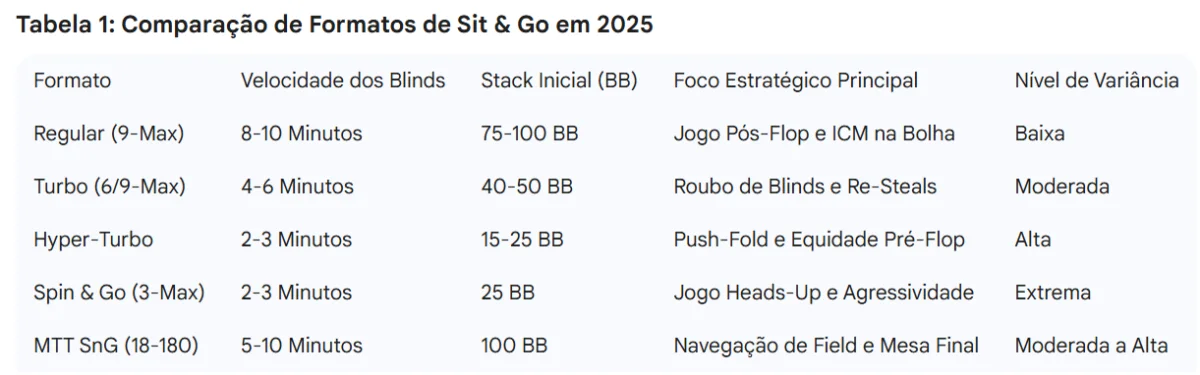
Technological evolution has allowed analysis software such as ICMIZER 3 and GTO Wizard to transform the understanding of the "short stack" game, making knowledge of these tools a prerequisite for profitability. The modern player must therefore master not just the cards, but the technological and mathematical environment that defines long-term success.
Theoretical Foundations and Tournament Psychology
The basis of any profitable strategy in 2025 lies in understanding Gap Theory, originally proposed by David Sklansky and refined for the contemporary solver environment. This theory posits that it takes a significantly stronger hand to call a raise than to initiate it. In Sit & Go, where stack preservation is vital, Gap Theory acts as a protective mechanism, discouraging marginal out-of-position clashes that can compromise player equity before crucial phases.
The Dynamics of Chip Values and Tournament Equity
Unlike the cash game, where winning 1,000 chips increases the value of your bankroll in direct proportion, in SnG, each additional chip you accumulate is theoretically worth less than the previous chip. This is because the ultimate goal is not to win all the chips, but to secure a prize position. Losing the last chip, on the other hand, results in the total loss of any equity in the prize, creating a risk-reward asymmetry.
Mathematically, a player's equity (EV) in a Sit & Go can be approximated by the formula of probability of reaching each winning position multiplied by the value of that prize. Complexity arises when unequal stacks on the bubble create what we call the "Bubble Factor", which measures how much more expensive it is to lose a chip than to win.

This psychological and mathematical concept forces the player to adopt a stance of extreme patience in the initial levels, waiting for the moment when aggression will produce maximum fold equity. Patience is not just the absence of action, but the strategic waiting for situations of positive Expected Value (EV), avoiding "traps" of dominated hands like A-J or K-Q in early positions during the first levels.
Strategic Dynamics by Stages
Sit & Go is classically divided into three phases: initial, intermediate and final (bubble/heads-up). Each phase requires a distinct skill set and a psychological approach adapted to the stack depth in relation to the blinds.
Initial Phase: The Art of Preservation
At the first levels (e.g. 10/20, 15/30), the stacks are deep (75-100 BB). The dominant strategy in 2025 remains the conservative Tight-Aggressive (TAG) game. The most common mistake seen in beginning players at this stage is over-involvement in multi-way pots with marginal hands, such as low suited connectors or small pairs out of position.
The experts' recommendation is to focus on "Category 1" hands (AA, KK, QQ, AK) and play them aggressively to build the pot or force mistakes from your opponents. However, elaborate bluffs should be avoided at this stage, as the low blinds do not justify the risk of losing a significant part of the stack. Position in poker is power, and in early SnG, it serves to control the size of the pot and gather valuable information about opponents' tendencies before the blinds become prohibitive.
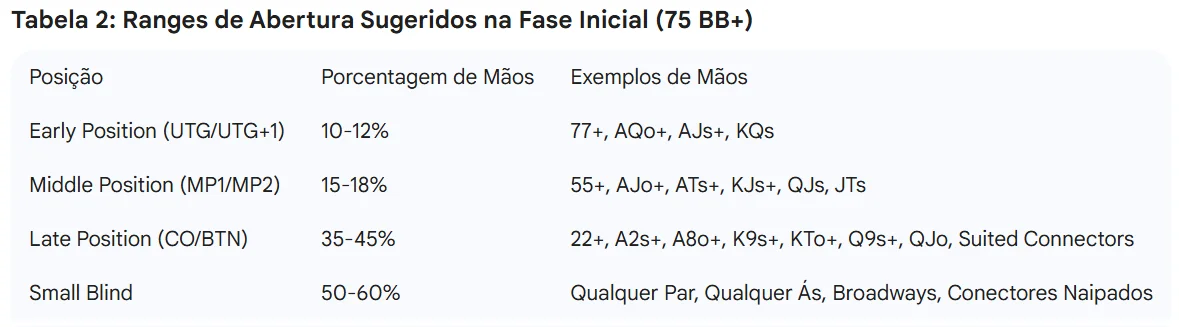
It is noted that the "limp" (just completing the blind) should be almost completely eliminated, except in specific situations with small pairs to try for a set in passive multi-way pots, although the modern trend is to raise directly to take the initiative.
Intermediate Phase: The Transition to Aggressiveness
The middle phase begins when the blinds increase and the average stack drops to 15-25 BBs. Here, passive survival becomes a guaranteed defeat strategy. The player must "shift gears" and start stealing the blinds to keep his stack competitive.
Blind stealing becomes the main source of income. In 2025, the size of the increases changed; While in the past the standard was 3x the blind, today the minimum raise (2x or 2.2x) is preferred to exert pressure while saving chips in case an opponent goes all-in. Identifying "nit" opponents (who play excessively tight) in the blinds is crucial to increasing steal frequency.
Final Phase and the "Push-Fold"
When the stack reaches 10-12 big blinds or less, postflop play practically disappears. The only valid strategic decision is "all-in or fold". This approach maximizes fold equity, forcing opponents to make do-or-die decisions in the tournament with hands they would rather not call.
The final phase also includes the "bubble", the moment when one player is missing for the prizes to begin. In 2025, bubble dominance is the divide between recreational and professional players. Large stacks should pressure medium stacks, while small stacks should look for opportunities to double up against other small stacks or through all-ins against blinds from overly fearful players.
The Independent Token Model (ICM) and Bubble Fairness
The ICM (Independent Chip Model) is the mathematical tool that translates chip stacks into real monetary value. In Sit & Go, the ICM is the final arbiter of strategic truth. It reveals why, in certain bubble situations, it may be okay to fold hands like K-K or A-Q against an all-in from a larger stack if your survival will guarantee the prize due to an extremely short stack in another position.
Bubble Factor and Decision Making
The Bubble Factor quantifies risk aversion. If your Bubble Factor against an opponent is 2.0, you need twice the equity as you would in a cash game for a call to be profitable.
- Large Stacks: They have low Bubble Factors against smaller stacks, allowing for almost unpunished aggression.
- Medium Stacks: They are in the most precarious position. They have more to lose if they are eliminated and therefore should play conservatively against big stacks and aggressively against small stacks.
- Small Stacks: They have high survival equity, but little pressure power. They should be selective and aggressive at the same time, focusing on open-shoves rather than calling all-ins of others.
2025 trends show that the use of ICM solvers like ICMIZER has allowed players to "solve" bubbles, making the game much more aggressive and accurate than in previous decades.
Tools and Technology: The Modern Gamer's Arsenal
Sit & Go poker in 2025 is inseparable from technology. Playing without the support of analysis and monitoring software is like "flying blind" in a high-precision environment.
Tracking Software and HUDs
Trackers like PokerTracker 4 and Hold'em Manager 3 remain fundamental. They allow the creation of a HUD (Heads-Up Display) that overlays crucial statistics on opponents in real time. In 2025, the most valued statistics for SnG are:
- VPIP/PFR: Measures pre-flop looseness and aggressiveness.
- 3-Bet/Fold to 3-Bet: Essential for identifying re-steal opportunities in the intermediate phase.
- Fold to Steal: Identifies "weak" blinds that can be systematically exploited.
- C-Bet/Fold to C-Bet: Informs the probability of an opponent folding after the flop when faced with a continuation bet.
ICM Solvers and Trainers
Tools like ICMIZER 3 and GTO Wizard have revolutionized post-session studying. ICMIZER allows you to simulate exact bubble situations to determine whether a "shove" or a "call" was mathematically profitable (+EV). GTO Wizard, in turn, offers balancing solutions for pots with higher blinds, teaching the player to be unexploitable in heads-up and shorthanded situations.
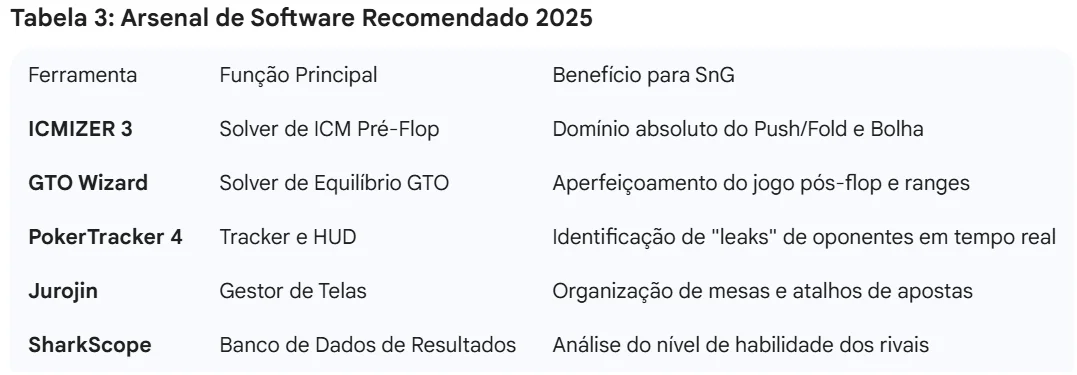
The integration of these tools allows for massive data analysis (MDA), where the player can identify global flaws in the population of a given site or betting level and create devastating exploratory strategies.
Exploring Population Trends in Micro-Stakes
Despite the ubiquity of GTO theory, the biggest profits in 2025, especially in micro-stakes (buy-ins up to $5), come from exploiting the glaring flaws of recreational opponents and weak "regulars."
Identifying Leaks and Executing Exploits
The micro-stake population exhibits predictable trends that can be capitalized on through deliberate adjustments:
- Under-Bluffing: Most players at low levels don't bluff enough, especially on the turn and river. The exploratory adjustment is to fold marginal hands (overfolding) against large bets at these stages.
- Sticky Calling Stations: Players who cannot fold middle pairs or marginal hands. The adjustment is to increase the value of bets (sizing) with strong hands and eliminate multiple shot bluffs (triple barrel) against these profiles.
- Passivity in the Blinds: Many micro-stakes "regs" play too many tables and end up operating on autopilot, giving up too much of the blinds. The adjustment is to drastically increase the frequency of button steal and hijack.
- Excessive Respect for 3-Bets: In micro-stakes, a 3-bet is almost always a sign of extreme strength (JJ+, AK). The adjustment is to give up everything except the top of the range unless the opponent has proven aggressive stats.
Patience is the ultimate weapon in micro-stakes. While opponents eliminate each other in unnecessary clashes at low levels, the disciplined player waits to capitalize on ICM's "leaks" in the bubble, where the fear of losing the prize paralyzes most competitors.
Sit & Go vs. Spin & Go: Strategic Divergences
One of the biggest questions for players in 2025 is the choice between traditional Sit & Go and Spin & Go. Although both share the "sit down and go" nature, the structures and technical requirements differ considerably.
Spin & Go is a 3-player hyper-turbo format with short starting stacks (usually 25 BB) and a randomized prize structure that can reach 10,000x the buy-in. While traditional SnG rewards survival management and ICM, Spin & Go rewards shorthanded aggression and technical excellence in Heads-Up.
Key Differences in Execution
- Stack Depth: In SnG, you play a lot of time with 30-50 BB. In Spin, you are almost always below 20 BB, which requires perfect mastery of shove/fold and min-raise/fold ranges.
- ICM vs. EV Chip: In single-table SnG, ICM is king. In Spin & Go (winner takes all most of the time), the game is purely focused on Chip EV (expected value in chips), making decisions mathematically more straightforward, but more frequent.
- Volume and Variance: Spins allow for massive volume due to the speed of the matches (less than 10 minutes), but the variance is much higher due to the multipliers and prize structure.
Professionals recommend that beginners start with regular SnGs to learn patience and stage structure before moving on to the technical "crunch" of Spin & Gos.
Banking Management and the Psychology of Volume
Longevity in online poker in 2025 depends entirely on bankroll management and mental resilience. Sit & Go is a high variance format where downswings of 20 to 50 buy-ins are statistically normal, even for winning players.
Banking Requirements for 2025
The table below defines safe standards for different SnG modalities, taking into account speed and field.
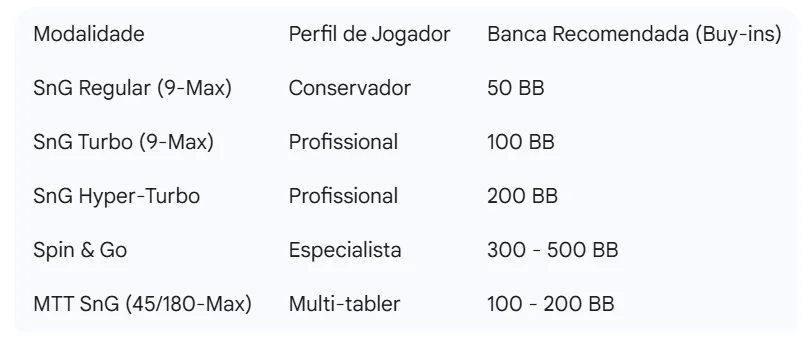
The psychology of volume is also crucial. Playing 24 tables simultaneously, as was common in 2010, has become less profitable in 2025 due to the increase in the average skill level. The current trend is to reduce the number of tables (4 to 8) to ensure that each decision is high quality and based on specific data from the opponents present. Professional success is now a marathon of efficiency, not a sprint of raw volume.
Conclusion and Future Perspectives
Sit & Go in 2025 remains one of the most stable pillars of online poker for those looking to build a bankroll in a methodical way. The transition from luck to skill in this format occurs at the intersection between the psychological discipline and the mathematical rigor of the ICM. While the game continues to evolve towards faster, more aggressive structures, the fundamentals of stack preservation and late position aggression remain unchanged.
For the future, virtual reality (VR) and generative artificial intelligence are expected to create new layers of gaming and training experiences, personalizing learning for each player almost instantly. However, the essence of poker will remain the same: the art of exploiting human error through strategic precision. Mastering Sit & Go today means ensuring you have the tools necessary to dominate any other tournament variant tomorrow.
References
- PokerStars. "Sit & Go Intermediate Phase: Basic Strategy and Phases".
- Casino Barcelona. "Complete strategy guide for Sit & Go tournaments".
- PokerListings. "How to Beat Poker Sit & Go's: A Complete Strategy Guide (2025)".
- PokerListings. "Essential Sit & Go Strategy Part 1: Early and Mid Levels".
- PokerNews. "The Best Poker Tools and Software for 2025: Trackers and Solvers".
- GipsyTeam. "Most Useful Poker Software 2025: PokerTracker 4 and HUDs".
- GTO Wizard. "How Significant is ICM: Preflop and Postflop Trends (2025)".
- PokerListings. "Complete Strategy Guide: Position and Gap Theory".
- VIP-Grinders. "Sit & Go Tournaments (SNGs) and Spin & Go Strategy 2025".
- Smart Poker Study. "Sit & Go Early Stage Open-Raising Ranges and Strategies".
- BlackRain79. "65 Ways to Increase Your Winrate at Micro Stakes (2025)".
- PokerNews. "888poker Tips to Crush Sit & Go: Payouts and Bubble Play".
- Smart Poker Study. "ICM in Sit & Go Tournaments: Equity and Strategy".
- YouTube (Sky Matsuhashi). "How to use Sit N Go End Game Tools (SNG EGT)".
- BlackRain79. "The State of Micro Stakes Online Poker in 2025".
- GTO Wizard. "How to Review ICM Preflop Ranges and Bubble Factors".
- PokerCoaching (Jonathan Little). "Top 10 Winning Sit and Go Strategy Tips".
- Pokerati. "Best Poker Software and Tools in 2025: ICMIZER and GTO Wizard".
- Reddit (r/poker). "Microstakes Leaks and MDA Population Exploits".
- TwoPlusTwo Forum. "Population Trends and Exploits in Online Poker".
- TwoPlusTwo. "Basic Sit 'n Go Questions: Bet Sizing and Stages".
- YouTube (888poker). "5 Tips to Master Sit & Go Format".
- PokerVIP. "Comprehensive Poker Sit n Go Strategy: Early and End Game".
- BlackRain79. "Tactical Strategy for Micro Stakes: Target Fish and Regs".
- CardsChat. "Ask Moshman: ICM and Push/Fold Stack Tips".
- BlackRain79. "Top 10 Common Poker Mistakes and Variance Management".
- ICMIZER. "ICMIZER 3: Preflop ICM GTO Push/Fold Solver".
- VIP-Grinders. "Spin & Go vs Sit & Go: Key Strategic Differentiators".
- PokerCoachO. "Sit and Go Poker Strategy: GTO or Exploitative?".
- Poker.org. "Jackpot Sit and Go: Multipliers and Rules".
- ThePokerBank. "Basic SNG Strategy: Chip Value vs Prize Pool Equity".
- PokerStars. "Spin & Go vs Sit & Go: What's the Difference?".
- PokerCoaching. "Spin and Go Poker: Popularity and Quick Formats".
Want to Learn More? Explore: Sit & Go
Related Posts

How to Exploit Recreational Players in Poker
Learn how to exploit recreational poker players with practical strategies for Cash Games, MTTs, Sit & Go tournaments, and Online Poker.

How to Build Poker Ranges Like Winning Players
Learn how to build poker ranges correctly, improve your preflop decisions, and increase your profits in cash games, tournaments, and Sit & Go events.

Exploitative Poker Strategy: How to Maximize Profits
Learn what exploitative poker strategy is, how to identify opponent weaknesses, and maximize profits in cash games, MTTs, and Sit & Go tournaments.