

The Strategic Dynamics of Ace-King in Texas Hold’em
AK in Texas Hold’em requires calculated aggression, use of blockers and reading ranges to maximize EV and avoid costly mistakes.

The Strategic Dynamics of Ace-King in Texas Hold’em: A Technical Analysis of Probabilities, Game Theory, and Behavior
Ace-King (AK), popularly known in poker culture as Big Slick, represents one of the most complex and often misunderstood hands in the No Limit Texas Hold’em ecosystem. Although it is statistically among the three best starting hands — surpassed only by the pairs of Aces (AA) and Kings (KK) — its nature as a "drawing hand" requires the practitioner to navigate between the aggressiveness necessary to extract value and the prudence essential to avoid catastrophic losses. This report exhaustively analyzes the mathematical underpinnings, pre- and post-flop strategic ramifications, and psychological nuances that make AK a fundamental pillar of long-term profitability for professional players.
Combinatorial and Probabilistic Fundamentals
Understanding the strength of the Ace-King begins with basic combinatorial analysis. In a deck of 52 cards, there are 1,326 possible starting hand combinations. The Ace-King is made up of 16 total combinations, 12 combinations of different suits (AK offsuit or AKo) and 4 combinations of the same suit (AK suited or AKs). The probability of a player receiving any AK is approximately 1.21%, which means the hand will be dealt about once every 82 hands played. The distinction between the suited and offsuit versions, while subtle in terms of raw preflop equity, becomes dramatic in postflop equity realization. AKs offer approximately 2% to 4% more overall equity than AKo against an opponent's average range, but their true advantage lies in superior playability and the potential to form the "nut flush" (the best possible flush), which allows for more aggressive semi-bluffs and greater variance protection.
Relative Equity and Head-to-Head Confrontations
The value of Ace-King is defined by its performance against different categories of hands. In poker, equity represents the theoretical percentage of the pot that a hand is expected to win at showdown. AK is often referred to as "Anna Kournikova" because, like the famous tennis player, the hand has an excellent appearance but can fail to deliver results if not handled with technical precision.
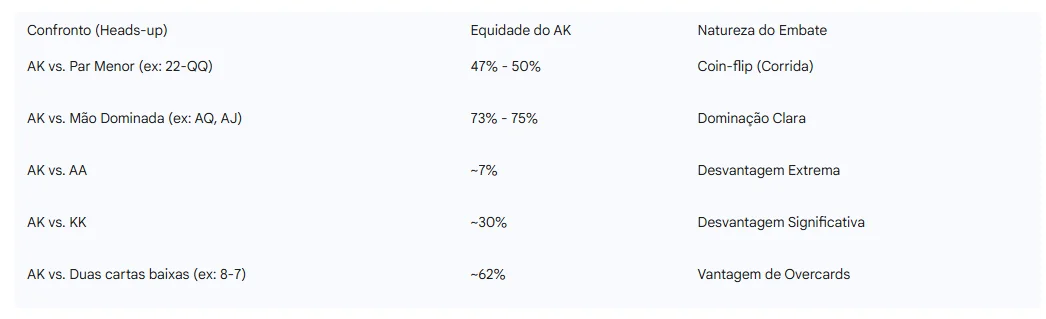
The table above illustrates why AK is such a powerful tool for 3-betting and 4-betting. He dominates hands that opponents often use to call raises (AQ, AJ, KQ) and retains almost half the equity against middle and low pairs. Against dominated hands, such as Ace-Jack (AJ), AK wins approximately 95% of the time when both hit pocket Aces on the flop, a phenomenon known as "kicking" or kicker disadvantage.
The Card Removal Mechanism (Blockers)
One of the most advanced concepts in modern poker theory is the card removal effect, or blockers. By holding an Ace and a King, the player physically reduces the AA and KK combinations available to opponents. Mathematically, there are 6 combinations of each pair in the deck. When the hero has an Ace and a King, the villain's AA combinations drop from 6 to 3, as do KK. This 50% reduction in the probability of facing absolute "monsters" justifies aggressive 4-bet and 5-bet shove play with AK, especially in 6-max games or blind-stealing positions. The AK acts as a probabilistic shield, making it statistically less likely that the player's aggression will be punished by the only two hands that severely dominate him.
Pre-Flop Strategy: The Art of Initiative
The fundamental rule for playing Ace-King is maintaining the initiative. AK should rarely be played passively, as its "fold equity" value (probability of making your opponent fold) is a vital component of your total profit.
Initial Raises and 3-bets
Regardless of the position at the table, when the action reaches a "gap" (doubled) for the player, the AK must always be opened with a raise. The act of "limping" (just paying the big blind) is considered a primary strategic error, as it fails to reduce the field of players and does not build the pot for times when the hand improves on the flop. When facing an initial raise from another player, the standard response with AK should be to 3-bet (a further raise). This isolates the original opponent, allowing AK to realize his equity in a heads-up pot where his strength is maximized. In multi-way pots (with many players), AK equity is quickly diluted as the probability of someone hitting two unlikely pairs or a straight increases.
The Dynamics of 4-bets and the Pre-Flop All-in
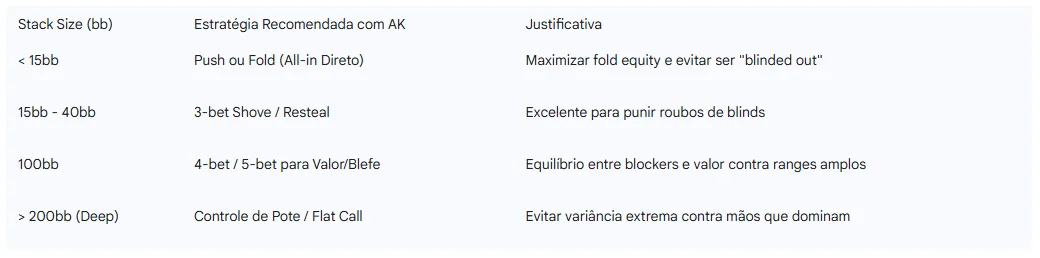
The decision to go all-in pre-flop with AK depends fundamentally on the depth of the stacks and the profile of the opponent. In standard stacks of 100 big blinds (100bb), AK is often strong enough to be played for all chips, especially in Late Position vs. Blinds.
However, against extremely conservative opponents (known as "nits"), aggressiveness must be tempered. If a player who only raises with AA or KK fires a 4-bet, AK may, on rare occasions, be folded or just called to see the flop. GTO (Game Theory Optimal) analysis suggests that AKo can be used as a "calling" hand against 3-bets from early positions to strengthen the defensive range and avoid being exploited by opponents who bluff little.
Post-Flop Navigation: The Challenge of Hit and Miss
Ace-King is a hand that "misses" the flop most of the time. Statistically, AK will fail to flop a pair approximately 66.7% of the time (two out of three times). This statistic is the root of frustration for many beginning players, but for the professional, it is just a mathematical variable to be managed.
When the Flop Connects: Top Pair Top Kicker (TPTK)
When an Ace or a King appears on the flop, the player has TPTK, a hand of immense value, but one that requires caution against sudden aggression. In single-raise pots, TPTK must be value-bet (c-bet) to extract chips from hands like AQ, AJ, or KQ. In 3-bet or 4-bet pots, where the Stack-to-Pot Ratio (SPR) is low, pot commitment is usually unavoidable. However, on highly connected boards like Q-J-T or J-T-9, TPTK may be behind full straights or two pairs. The literature suggests that, in 3-bet pots, the c-bet size should be reduced (about 33% of the pot) on Ace or King boards to keep worse hands in the pot and protect the hero's checking range.
When the Flop Doesn't Help: The Aggressor's Continuity
Missing the flop with AK does not mean giving up the hand. Due to the pre-flop initiative, hero can often win the pot through continuation bets. AK keeps six "outs" (cards that improve him) to the top of the range on almost any flop. On dry, disconnected boards (e.g. 7-2-4), AK should trigger a bluff c-bet, as the defender's range will rarely have connected with such cards. Additionally, AK has "backdoor equity" (possibility to form a strong hand on the turn and river) in many textures. If the flop offers a flush draw or gutshot, AK becomes an ideal semi-bluff.
Recognizing Dangerous Boards
The ability to identify board textures that disadvantage AK is what sets profitable players apart. "Wet" boards with lots of medium card connections (e.g. $9-8-7$ or $6-5-4$) are disastrous for AK. In these scenarios, if there are multiple opponents or if the hero faces a high bet, folding is often the most correct path, avoiding the classic mistake of "marrying" the hand.
AK Suited versus AK Offsuit: A Difference in Millions
AK technical analysis would not be complete without an in-depth exploration of the suited version (AKs). Although both hands share the same pair value, AKs are a much more resilient strategic tool. AKs have the ability to realize their equity much more efficiently. In situations where AKo would be forced to check-fold after a flop that did not bring Ace or King, AKs can continue if there is a flush draw. This allows the player to keep up the pressure and occasionally win massive pots when the flush is completed on the river — a flush that will always be the nuts, eliminating the risk of losing to a bigger flush. Additionally, in multi-way pots and games with deep stacks, AKs gain exponential value due to their "implied odds" properties. The ability to win the entire stack of an opponent who has a lower flush or a straight is a trait that AKo simply does not have.
The Ace-King in Tournaments: Pressure, ICM and the Bubble
In tournaments, the AK strategy must be adjusted according to the phase of the game and the prize structure. AK is one of the hands most affected by the concept of ICM (Independent Chip Model), which dictates that the value of lost chips is greater than the value of won chips.
Early Stages and Chip Accumulation
At the start of a tournament, with stacks of 100bb or more, AK should be played similar to a cash game, focusing on building a solid stack through disciplined 3-bets and c-bets. The common mistake at this stage is to risk the entire tournament on an unnecessary 100bb coin-flip, when there is still plenty of room for post-flop play.
The Bubble and the Final Table
As the tournament gets closer to the prize pool (bubble) or final table, the value of AK as an all-in hand increases dramatically due to the Antes and high blinds. With stacks of 20bb to 30bb, AK is the restal hand par excellence. If a player raises from late position and the hero is in the blinds with AK, the straight all-in (shove) is often the play with the highest Expected Value (EV+), as it combines the high equity of the hand with the high chance of the opponent folding marginal hands.On the bubble, however, one must be aware of stack size. If the hero is one of the medium stacks and faces an all-in from a giant stack, AK can, in extreme ICM situations, be a fold, prioritizing survival to guarantee the money.
Analysis of Common Errors and Psychological Biases
AK is perhaps the most tilting hand in the history of poker. The discrepancy between your perceived strength and your actual performance in short sessions creates a psychological trap for the unsuspecting player.
The Error of Passivity (Call with AK)
One of the most frequent mistakes, highlighted by professional Lali Tournier, is playing AK passively, just calling raises to "see the flop". This approach strips AK of its greatest weapon: fold equity. By just calling, the player allows the opponent to hold hands that he would dominate, such as $A-5$ suited or $K-J$, and which could end up winning the pot if they hit two pairs or a straight.
The Error of Overvaluation (Treating AK as AA)
Many players feel "betrayed" when they lose with AK to a pair of 3s that didn't fold preflop. It's vital to remember that AK is technically just "Ace-high" until the flop is revealed. Going all-in against an extremely conservative player who only 4-bets with AA or KK is a range reading error. The AK is a formidable hand, but it is not invincible.
Anna Kournikova Syndrome and Lack of Adaptation
The nickname Anna Kournikova reflects the frustration of seeing a beautiful hand lose. The mistake here is emotional: the player starts to believe that AK is a "cursed" hand and starts to play it badly out of fear. Selective memory makes the practitioner remember the times AK lost the coin-flip, but forget the countless times he won the pot pre-flop without a fight or when he dominated an Ace-Queen.
Etymology and Culture: The Mysticism of "Big Slick"
The nomenclature surrounding Ace-King is rich and reveals a lot about the historical perception of the hand. The term "Big Slick" has origins dating back to the oil spill in Santa Barbara, California, and is a metaphor for something that appears attractive and valuable on the surface, but can cause disaster if not handled with extreme care. Another notorious nickname, "Walking Back to Houston", attributed to T.J. Cloutier, describes the fate of Texan gamblers who went all in with AK against low pairs in Dallas or Las Vegas and, after the defeat, they ran out of money for their passage, being forced to walk hundreds of kilometers back home. These stories serve as pedagogical reminders about the inherent variance of the hand.
Considerations on Modern Poker and Study Software
In the current competitive environment, studying with assistance tools is essential to master Ace-King. Software like Equilab (free) and GTO solvers like PioSOLVER have transformed the way AK is perceived. Systematic study allows the player to understand, for example, that AKo should be 4-bet with a specific frequency against the button, but perhaps only called against a UTG (Under the Gun) raise. Range analysis replaces intuition, allowing the player to make decisions based on exact mathematical frequencies, which minimizes the emotional impact of inevitable short-term losses.
The AK in Variations: Short Deck Poker
It is interesting to note how the value of the AK changes in game variations. In Short Deck Hold'em (where cards 2 to 5 are removed), AK gains even more value. As straights are easier to form and flushes are more difficult (and more valuable, even beating the full house in some rules), AK suited becomes an absolute elite hand, surpassing even hands that would be dominant in traditional poker.
Conclusion: Mastery in Using the Ace-King
Ace-King is not just a poker hand; it is a true test of discipline, mathematical understanding, and emotional control. For players striving for excellence, AK should be viewed as a high-volatility financial asset, capable of generating consistent long-term returns when played with precision. Success with “Big Slick” doesn’t rely on luck—it comes from calculated pre-flop aggression, strategic use of blockers to mitigate risk, and post-flop composure to know when to extract value or gracefully fold.
By combining combinatorial knowledge, probability analysis, and keen awareness of table dynamics, position, and stack depth, a player can transform what seems like a risky hand into one of the most profitable long-term tools. Mastery of AK involves playing correctly even in the 67% of hands where the board misses, relying on strategy, emotional control, and precise reads of opponents.
More than just cards, Ace-King is an exercise in risk management, patience, and applied intelligence. It rewards those who understand that poker is a game of consistent decisions, not immediate outcomes. Mastering Big Slick means recognizing that every hand is an opportunity to maximize EV, minimize losses, and turn variance into advantage. Ultimately, AK teaches that true power in poker lies not in the strength of the cards, but in a player’s ability to extract value with precision, confidence, and refined strategy.
Want to Learn More? Explore: Online Poker
Related Posts

How to Exploit Recreational Players in Poker
Learn how to exploit recreational poker players with practical strategies for Cash Games, MTTs, Sit & Go tournaments, and Online Poker.

How to Build Poker Ranges Like Winning Players
Learn how to build poker ranges correctly, improve your preflop decisions, and increase your profits in cash games, tournaments, and Sit & Go events.

Exploitative Poker Strategy: How to Maximize Profits
Learn what exploitative poker strategy is, how to identify opponent weaknesses, and maximize profits in cash games, MTTs, and Sit & Go tournaments.